Voltage protection module
About this page
This page was written by the New Horizons engineering team, which operated until December 2025. First-person references ("we", "our") are the original authors'. A number of those authors are now working with Phoenix GH, which maintains this material and stands behind it. Questions and comments are welcome — please get in touch.
The need
As noted in the overview, mains power quality in low- and middle-income countries (LMICs) can be problematic. Voltage that is too low or too high can damage equipment, so that it cannot perform its intended function. Fast high-voltage impulsive transients (sometimes called “surges”) are another risk to appliances, whether the source is a remote lightning strike or large equipment turning on or off in the vicinity. This situation affects many kinds of equipment, but the potential human cost is high in the field of healthcare.
Voltage stabilizers, such as those that comply with the WHO specification WHO/PQS/E007/VS01.6 can protect vaccine cold-chain equipment, ensuring that their compressors always operate within their rated voltage range. Many appliances, including those in a healthcare setting, do not require the voltage compensation feature of voltage stabilizers because they incorporate so-called “universal” input AC/DC power supplies. These supplies are designed to work over worldwide nominal voltages between 100 and 240 V, often having operational ranges from 84 V to 264 V to accommodate mains voltage tolerances. Equipment using them can operate normally even if the mains voltage is much lower than many locations’ nominal 230 V.
However, these off-the-shelf AC/DC power supplies often do need additional protection against the higher overvoltage levels observed in LMIC healthcare settings. Protection devices are available on the market, either as separate devices that plug into a wall outlet and provide a protected outlet for appliances, or as modules that can be integrated into appliances. But these either do not protect up to observed voltage levels (500 V continuous); turn off relatively slowly, risking damage to equipment; or do not allow operation over the full voltage range usable to universal-input power supplies.
Protection module
New Horizons has created and used a series of voltage protection circuits in our own designs and in collaborations with others. The design shared here is the evolution of those circuits in a form that can be placed in-line in a power cord for a piece of equipment. It uses standard IEC 60320 C14 input and "Type F" output connectors so that appropriate power cords can be connected for the country of use.
The design is open source hardware, licensed under the CERN-OHL-P v2 license, meaning that it may be used and modified, even commercially. See the details in the license file within the package.
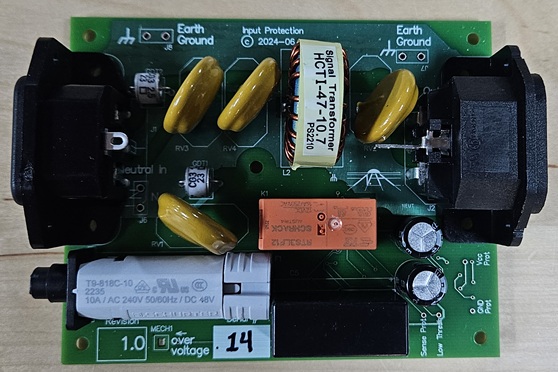
Specifications and functions
- Protection against continuous voltages:
- Low voltage cut-out and cut-in thresholds: 87 V and 95 V.
- High voltage cut-in and cut-out thresholds: 269 V and 273 V.
- Withstands continuous overvoltage > 500 VAC.
- Protection against impulsive transients:
- An impulse with a 2 kV peak results in a peak voltage at the output < 750 Vpk.
- Protects and survives an impulse that occurs during a sustained overvoltage.
- Symmetric impulse protection between line-earth and neutral-earth. (i.e., it has the same clamping levels if the neutral and line are reversed.)
- Current rating: 10 A.
- Current protection: inexpensive on-board breaker.
- Enclosure IP rating: IP40 (1 mm objects excluded, no water protection).
Downloads
Contained in the following zip file package are the following folders:
- Docs: A general description of the module and its approach, along with more detailed notes on simulations that preceded the design and the design process.
- ECAD_PCB: Altium source files and output fabrication and assembly files (Schematics, Gerber, Bill of Materials, etc.).
- ECAD_sim: Altium simulation files of the impulse suppression design.
- MCAD: Solidworks, STL and STEP files of the enclosure designed for the PCBA.
Voltage Protection Module Package (zip)
Variant: Heater stabilization
This variant is intended to control the average power a heating element, such as the element in the "charger" for the Indigo portable vaccine cooler. It combines the input protection circuit with a triac and zero-crossing control to switch power to the heater. A low-cost microcontroller measures voltage and controls the triac to manage average power. It can be lighter weight than a tap-changing voltage stabilizer, but has the disadvantage that the peak current is high when operating near the nominal voltage. The hardware package contains Altium source files and the output fabrication and assembly files, along with documentation of the design. Source firmware for the microcontroller written in the Rust language is in the firmware package.
Heater Protection and Stabilizer Hardware Package (zip)
Heater Protection and Stabilizer Firmware Package (zip)
Contact
Contact: Rod Hinman
For more information, contact us about the voltage protection module.